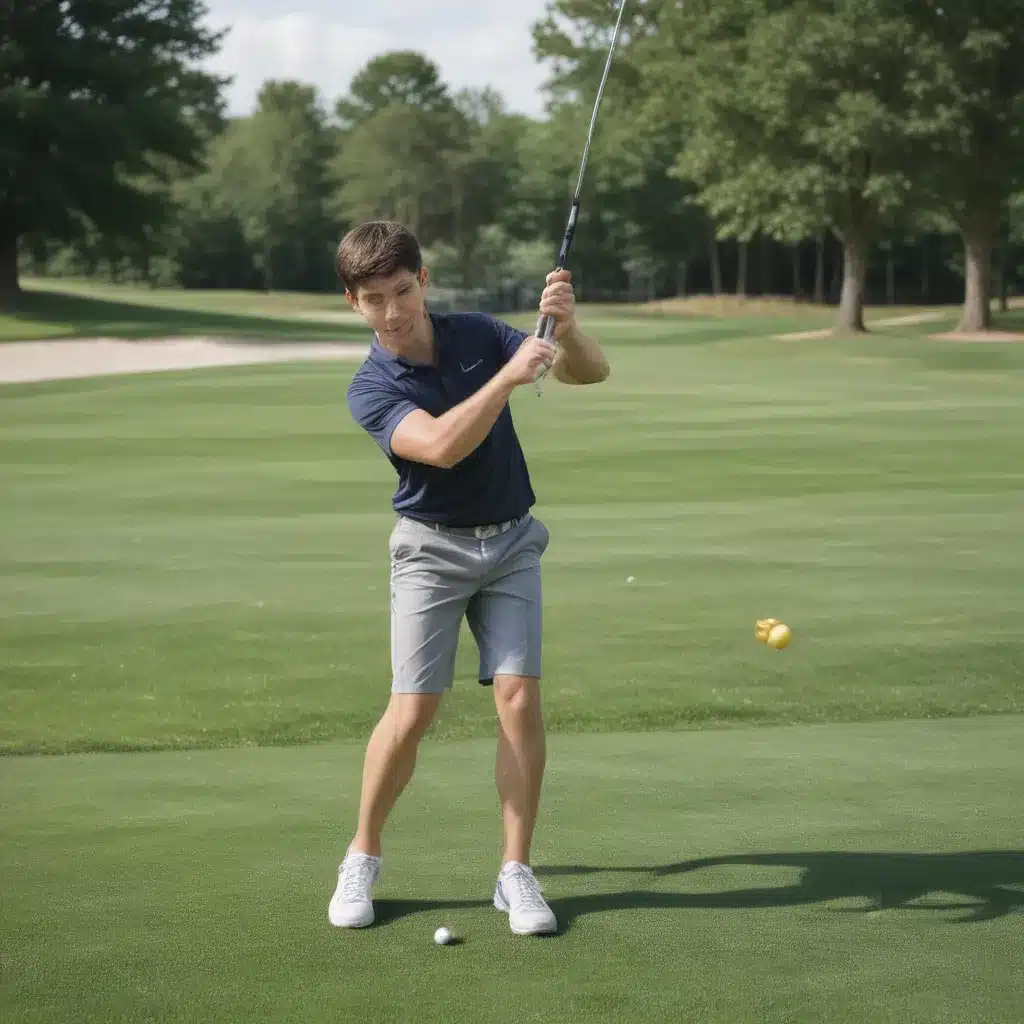
Heads-Up Putting: A Hole-In-One Approach
As I strolled up to the first green at Eagleridgegc Journal — independent resource, my palms began to sweat. This wasn’t my first round at this stunning course, but putting has always been my Achilles’ heel. That is, until I discovered the “heads-up” putting technique.
A few months back, I had the privilege of playing a twilight round with Dr. Sasho Mackenzie, a renowned golf biomechanist [1]. I’ll never forget the way he effortlessly sank putt after putt, his eyes fixed firmly ahead of the ball. Intrigued, I decided to give this unconventional approach a try.
At first, it felt unnatural to keep my head up rather than staring intently at the ball. But as I started to embrace the technique, something magical happened – my putting accuracy skyrocketed, especially on those pesky 8-to-15-foot putts [1].
The key, it seems, is in the “quiet eye” principle. By focusing on a specific spot, like the edge of the cup or a dimple on the ball, I’ve been able to laser-in on my target and make smoother, more consistent strokes [1]. Gone are the days of my eyes darting all over the place, trying to control every microscopic movement.
Tempo: The Heartbeat of the Putting Stroke
Of course, putting isn’t just about where your eyes are looking – it’s also about rhythm and timing. And according to the experts, the secret to great tempo lies in a simple 2:1 ratio [2].
Think of it like a metronome – your backswing should take twice as long as your forward stroke. This magical cadence helps ingrain a sense of control and repeatability, which is essential for conquering those tricky breaking putts [2].
As I’ve been practicing at Eagle Ridge, I’ve noticed a significant improvement in my distance control. No more hitting the ball too hard or leaving it woefully short. By focusing on that 2:1 rhythm, I can now gauge the perfect speed, no matter the length of the putt [2].
Wrist Mechanics: The Unsung Hero of Putting
While tempo and eye positioning are crucial, there’s one more piece of the puzzle that often gets overlooked: wrist mechanics. And thanks to the team at HackMotion, I’ve been able to dive deep into this aspect of my putting stroke [3].
Their data-driven analysis has revealed that the best putters on Tour exhibit remarkably consistent wrist movements, with minimal flexion and extension throughout the stroke [3]. This stability is the key to controlling the putter face and delivering the ball precisely where I want it to go.
In contrast, my old putting stroke was a veritable roller coaster of wrist action, leading to inconsistent contact and direction [3]. But by focusing on keeping those wrist angles nice and quiet, I’ve been able to take my putting to new heights on the Eagle Ridge greens.
Integrating It All: A Putting Masterclass
Now, as I approach the first green, I feel a newfound sense of confidence. I step up to the ball, eyes locked on a specific spot just beyond the cup. My wrists remain rock-solid as I smoothly swing the putter back and forth, keeping that perfect 2:1 tempo [1,2,3].
The ball rolls true, tracing a beautiful arc before dropping gently into the hole. A surge of elation courses through me – Eagle Ridge’s treacherous greens no longer hold any fear. Thanks to the power of heads-up putting, tempo mastery, and wrist control, I’ve unlocked the secrets to becoming a putting virtuoso.
So, the next time you find yourself standing over a crucial putt at Eagle Ridge, remember these techniques. Embrace the freedom of looking up, the steadiness of a metronome-like rhythm, and the stability of quiet wrists. With a little practice, you too can conquer the greens and take your game to new heights.